
Harmonic Filters & IEEE 519 Solutions
AMP Magnetics is an independent manufacturer’s representative for specialized power-quality manufacturers delivering passive and active harmonic mitigation solutions.
Achieve < 5% THD-i and Meet IEEE 519-2022 Standards
Six-pulse variable frequency drives, induction heaters, and high-capacity battery chargers inject severe harmonic currents into industrial distribution systems. Left unchecked, harmonic currents distort the voltage sine wave, overheat upstream transformers, cause power factor capacitor failures, and trigger utility demand penalties.
As a manufacturer’s representative, AMP Magnetics connects your engineering team with domestic plants producing high-efficiency tuned passive harmonic filters and active harmonic filter solutions. These units eliminate the 5th, 7th, 11th, and 13th harmonic orders right at the source.
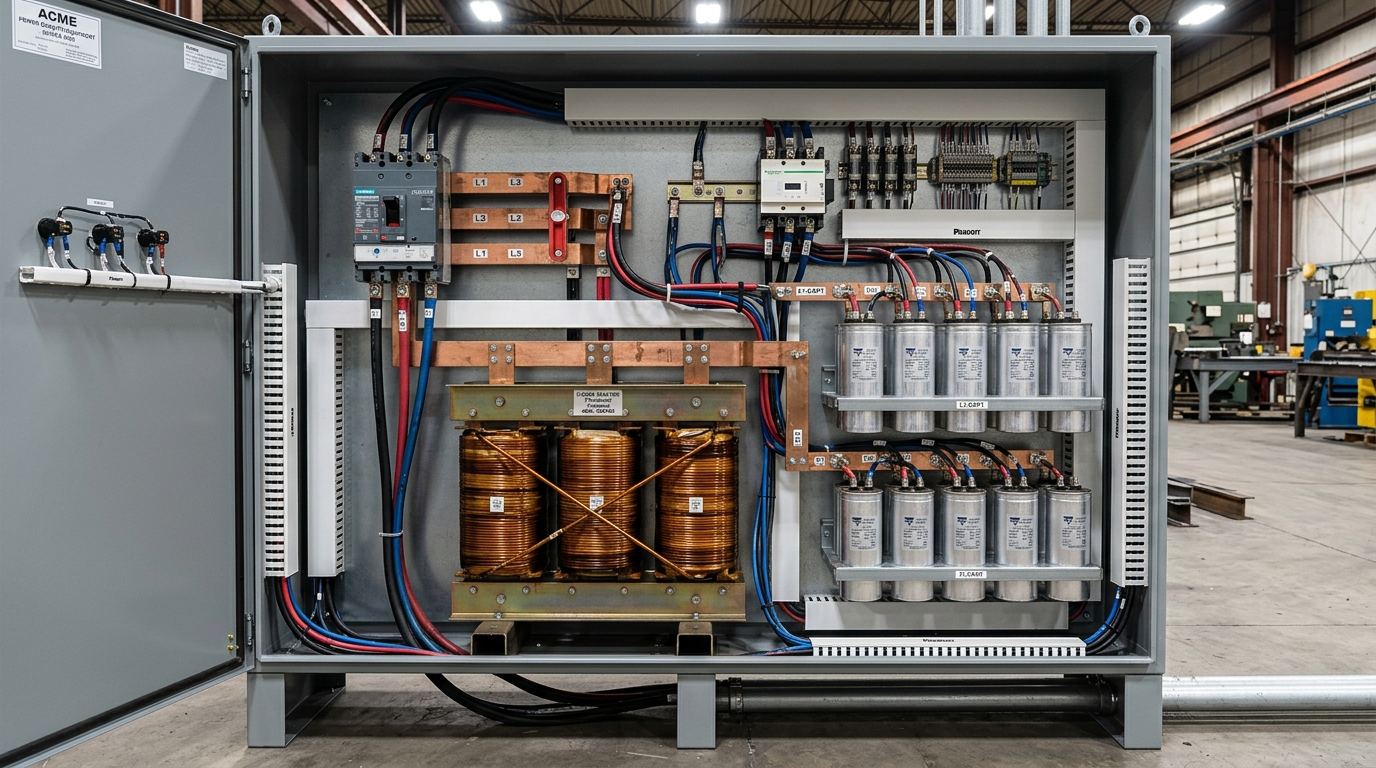
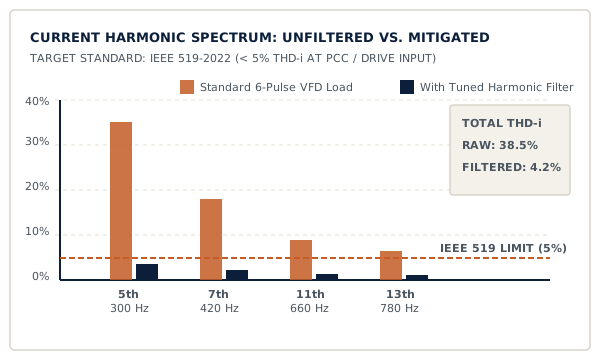
Passive vs. Active Harmonic Mitigation Topologies
Depending on your load diversity, available panel space, and budget, our represented principals build solutions across both primary topologies:
| Mitigation Technology | Typical Performance | Load Compatibility | Ideal Application Profile |
|---|---|---|---|
| Tuned Passive Harmonic Filters | < 5% or < 8% THD-i at full load | Individual VFDs or dedicated 6-pulse drives | Pumping stations, fan drives, wastewater treatment, and HVAC chillers with steady operating loads. High reliability, zero electronic maintenance, lowest initial capital cost. |
| Active Harmonic Filters (AHF) | < 3% - 5% THD-i dynamic tracking | Centralized switchboards, multi-drive lineups, mixed non-linear loads | Industrial automation cells, data centers, and facilities where drives cycle unpredictably. Dynamically injects counter-phase harmonic current and provides stepless power factor correction. |
| 12-Pulse / 18-Pulse Phase-Shifting Transformers | < 8% (12-pulse) / < 5% (18-pulse) | Multi-pulse drive rectifiers | Critical heavy industrial drives (> 500 HP), extruders, and mine hoists. Purely magnetic phase cancellation with robust electrical isolation. |
Generator Compatibility
Our represented passive filters feature optional contactor disconnect kits to drop the capacitive circuit at light loads, preventing voltage rise and generator AVR instability during emergency backup operation.
True Near-Unity Power Factor
In addition to filtering harmonic currents, the tuned trap network supplies fundamental reactive power, raising the operating power factor to > 0.95 across normal operating loads without causing leading power factor penalties.
Thermal Overload Protection
Heavy-duty magnetic coils wound with Class 220°C insulation systems and integrated thermal switches protect the unit against prolonged severe system overvoltages and resonance events.
Need to Meet Utility IEEE 519 Mandates?
Send your single-line diagram, utility Point of Common Coupling (PCC) short-circuit ratio, and drive schedule for a compliance review and factory pricing.
Request Harmonic Filter QuoteQuestions we get asked about Harmonic Filters
Where do IEEE 519 limits actually apply?
At the point of common coupling, normally the service entrance or utility transformer primary — not at individual drive terminals. Specifications written against drive terminals demand far more mitigation than the standard requires and can multiply the cost of compliance unnecessarily.
What information do you need before quoting a harmonic filter?
The location of the point of common coupling, the available short-circuit current there, the maximum demand load current, the existing background distortion if measured, and whether the site transfers to standby generator with drives running. The short-circuit to load current ratio sets the allowable distortion limit and can move it from 5 percent to 20 percent.
Will a passive harmonic filter work on a standby generator?
Only with design attention. Passive filters present leading power factor at light load, and generator voltage regulators are generally designed for lagging load, so instability is a real risk. Switched filter stages that disconnect capacitance at light load, or an active filter, are the usual answers. Generator operation must be stated before selection.
How do passive and active harmonic filters compare?
Both can achieve below 5 percent total demand distortion at rated load. Passive filters cost less, have no electronics and no service life limit, but degrade at part load and present leading power factor. Active filters hold performance across the load range and adapt to changing spectra, at higher first cost and with electronics to maintain.
Do harmonic filters interact with existing power factor correction capacitors?
Yes, and the interaction can be severe. Existing capacitance and system inductance can form a resonant circuit that amplifies a harmonic rather than reducing it. Any installation with existing power factor correction needs a resonance study before a passive filter is added.